
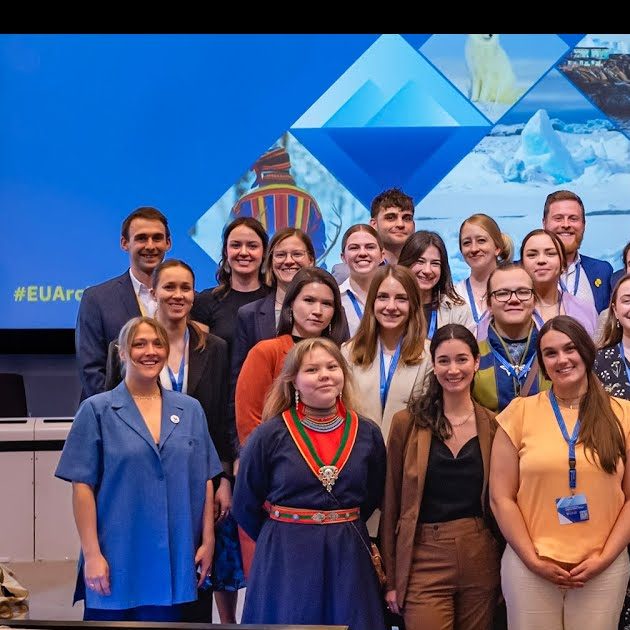
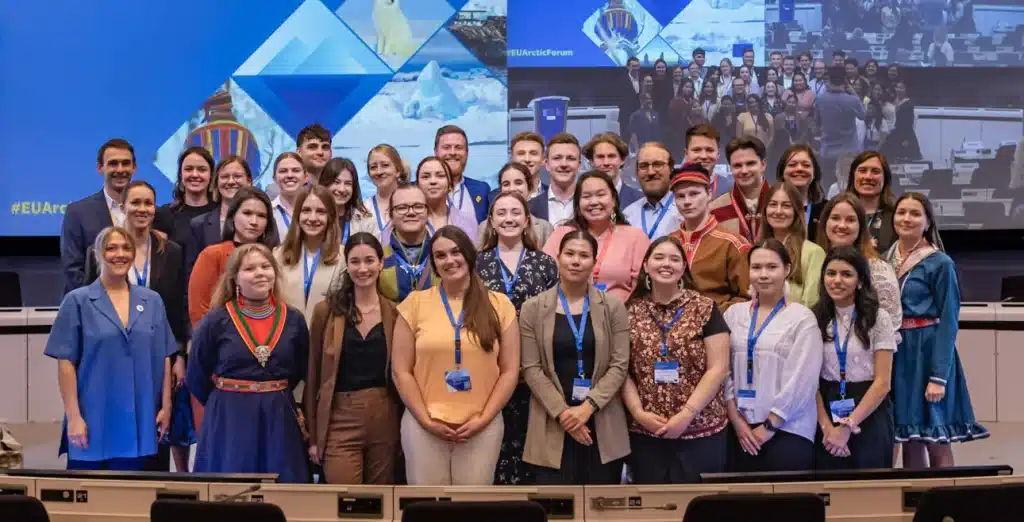
In May Laura Suorsa from Oulu, Finland travelled to Brussels to participate in the EU Arctic Youth Dialogue. This first AYD event gathered 32 young people, many from Arctic Mayors Forum member municipalities. Youth delegates joined in on workshops days over the weekend, and then participated in the EU Arctic Forum, Indigenous Peoples’ Dialogue, and finally hosted the EU Arctic Youth Dialogue.
The Youth Together for Arctic Futures project is led by the WWF Global Arctic Programme, in cooperation with Arctic partner organisations that bring to the table decades of experience in youth empowerment, policy shaping, as well as research and conservation of Arctic ecosystems and livelihoods. Arctic Mayors’ Forum joins this partner group together with Arctic Youth Network, Association of Polar Early Career Scientists, European Youth Parliament, Saami Council, Tromsø Kommune, and UiT the Arctic University of Norway.
Youth from across the Arctic and the EU gathered in Brussels to discuss challenges facing the region, and to develop a set of policy recommendations to address these challenges. They then presented their recommendations at the EU Arctic Youth Dialogue on May 15.
The policy recommendations were based on four distinct themes; Youth-inclusive planning and decision-making for the Arctic, economic incentives for nature protection and conservation, management of Arctic oceans, and climate adaptation in the Arctic. We reached out to Laura a few weeks after the event to hear about her experience at the dialogue.

Q: Tell us a bit about yourself and why you applied to participate in the EU Arctic Youth Dialogue?
A: I come from Oulu, Finland. I was born and raised here, but I have also lived in several big cities across Europe. I love Finland’s four distinct seasons, which is why I enjoy living here – and I hope these beautiful seasons will remain for future generations as well. I enjoy spending time in nature, and in winter, I go snowboarding as often as possible. I recently completed my International Business studies at the Oulu University of Applied Sciences, and I am also a member of the Youth Board of the Youth Together for Arctic Futures Project.
When I was offered the chance to apply to the EU Arctic Youth Dialogue, I eagerly wanted to join. I wanted to learn more about the decision-making process and how to amplify the voices of young people. My dream is to work in an Arctic city or municipality in the future, helping to create a place where youth thrive and choose to live. I am particularly interested in how youth are considered in city planning and the ways they are supported, so they can, for example, remain in their home municipalities in the Arctic. I thought the EU Arctic Youth Dialogue was a unique chance to hear and learn from other youth from the Arctic as well.
Q: What was your favorite part of the EU Arctic Youth Dialogue?
A: The best part of the EU Arctic Youth Dialogue was meeting the other youth from around the Arctic and Europe, and hearing their perspectives, stories, and lived experiences on various Arctic-related issues. It was inspiring to listen to so many intelligent young people. It also showed me that I am not alone with my concerns. I do my best to share the knowledge I gained during the AYD and inspire other youth in my city to become active citizens and participate in decision-making, and to help their voices be heard.
Q: Why do you think youth offer a unique perspective on Arctic policy issues? How do you think they can best be included in policy making?
A: Young people are very aware of the world we live in. They are creative and passionate about finding better and more sustainable solutions. I hope that in the future, there won’t be separate sessions for youth; instead, they will participate in the same panels, discussions, and policymaking processes as everyone else. Decisions that affect youth and the environment should especially be made by, or in collaboration with, young people.
Q: Is there any specific policy recommendation that sticks out to you as particularly important or impactful?
A: I believe all the recommendations made during the event were very important, but this one feels particularly significant to me: Bring Arctic youth-oriented institutional leaders and decision-makers to the Arctic to directly and continually engage with youth in their communities.
Rather than assuming what youth want and need, they should be actively listened to. This is crucial because it allows decision-makers to understand the situation in the place where a particular decision will have an impact. Additionally, decision-makers should travel to meet the youth in their communities to have a realistic picture of the situation instead of bringing together selected youth to share their perspectives.

The Youth Together for Arctic Futures project is led by the WWF Global Arctic Programme, in cooperation with organisations that bring decades of experience in youth empowerment, policy shaping, and research and conservation of Arctic ecosystems and livelihoods: Arctic Youth Network, European Youth Parliament, Saami Council, Arctic Mayors’ Forum, Tromsø commune, University of Tromsø, and the Association of Polar Early Career Scientists.